Comparatives and Superlatives in Everyday English
Comparatives and superlatives help us describe differences clearly. We use a comparative when we compare two people, things or situations. We use a superlative when one member of a group has the highest or lowest degree of a quality.
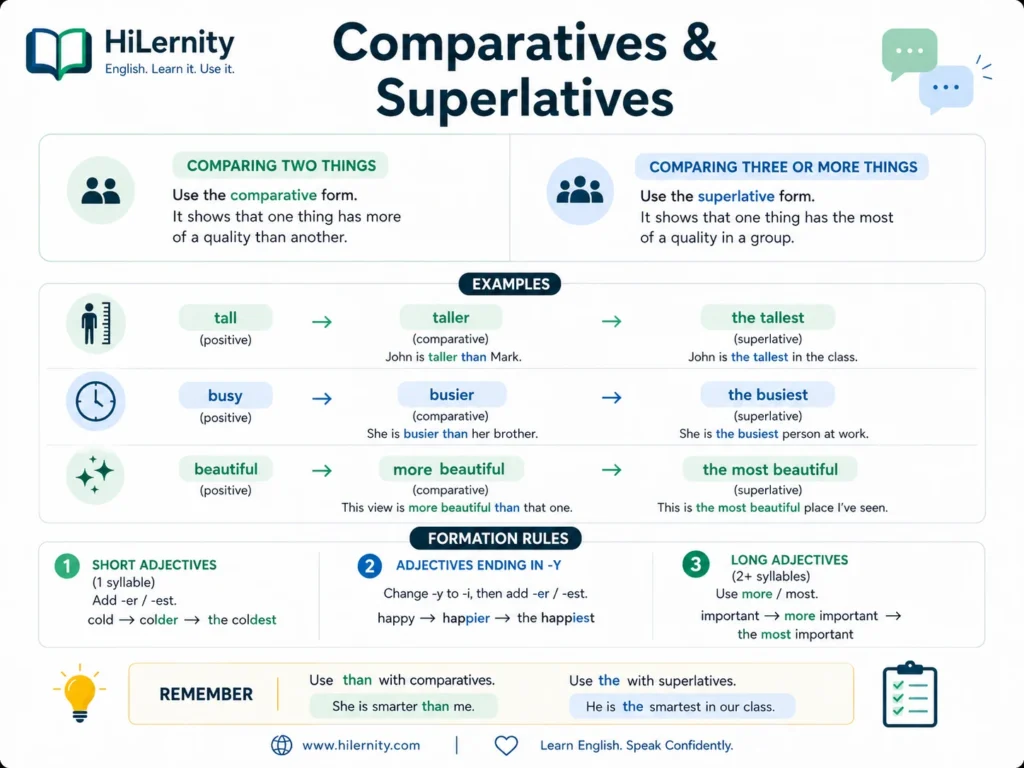
1. Comparatives: two things
With many short adjectives, add -er + than.
- Almaty is larger than my hometown.
- This exercise is easier than the previous one.
- Her explanation was clearer than mine.
With longer adjectives, use more + adjective + than:
- This course is more practical than the old one.
- The second option is more convenient than the first.
2. Superlatives: three or more
Use the + -est with many short adjectives and the most + adjective with longer adjectives.
- She is the fastest reader in the group.
- That was the most useful part of the workshop.
3. Spelling patterns
- small → smaller → the smallest
- busy → busier → the busiest (change y to i)
- big → bigger → the biggest (double the final consonant)
- comfortable → more comfortable → the most comfortable
4. Important irregular forms
- good → better → the best
- bad → worse → the worst
- far → farther/further → the farthest/furthest
5. Common mistakes
Do not use two comparative systems together:
more easier→ easiermore better→ better
Remember than for comparison: This one is cheaper than that one. Remember the with most superlatives: the cheapest option.
6. Comparatives are also useful for change
English uses paired comparatives to show development:
- My listening is getting better and better.
- The lessons are becoming more and more challenging.
Quick practice
Complete the sentences: (1) My new schedule is ___ (flexible) than before. (2) This is ___ (good) example in the article. (3) Today feels ___ (busy) than yesterday. (4) Which city is ___ (expensive) in the region?
Answers: more flexible; the best; busier; the most expensive.
Final tip: decide first whether you are comparing two things or choosing one from a group. That decision usually tells you whether you need a comparative or a superlative.
Want to practise this with a tutor?
Work through the topic one-to-one and get feedback that matches your level and learning goals.
Find an English Tutor