Interested vs Interesting: How -ed and -ing Adjectives Work
Interested and interesting are both correct words, but they describe different sides of the same situation. This pattern also appears in pairs such as bored/boring, excited/exciting and confused/confusing.
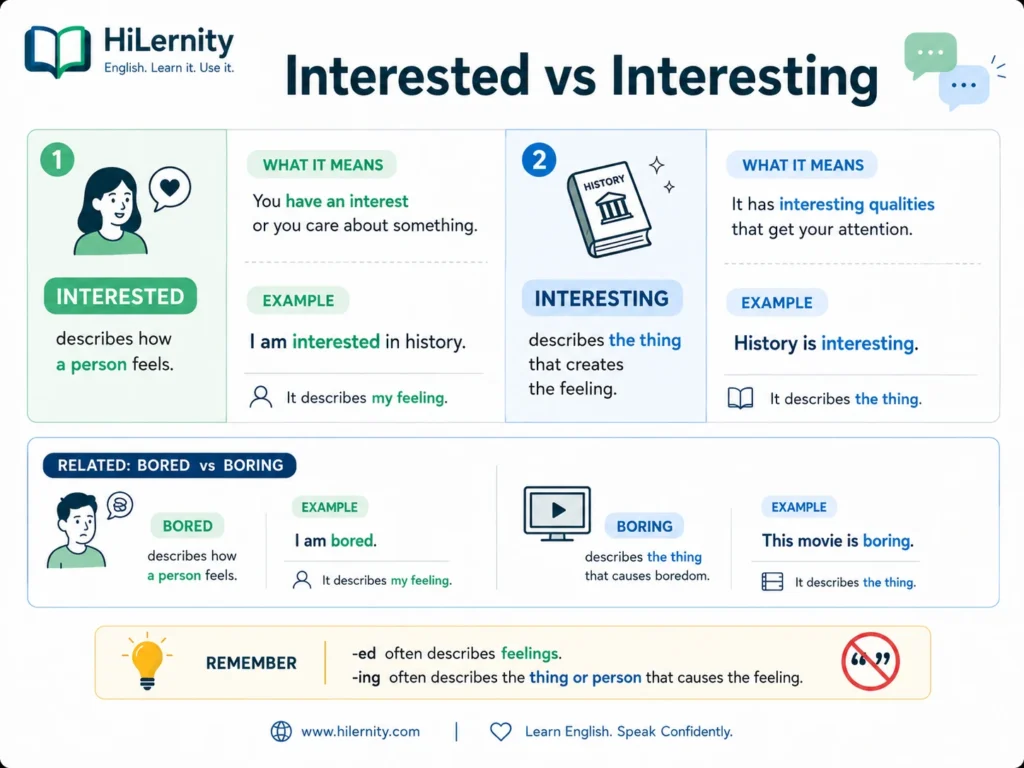
The simple rule
-ed adjectives usually describe how a person feels.
- I am interested in pronunciation.
- She was surprised by the result.
- They felt confused after the explanation.
-ing adjectives usually describe the person, thing or situation that creates the feeling.
- Pronunciation is interesting.
- The result was surprising.
- The explanation was confusing.
Why the mistake matters
If you say I am boring, you are not saying that you feel bored. You are saying that other people may find you boring. That is a very different message.
Useful pairs
- bored / boring
- excited / exciting
- tired / tiring
- amazed / amazing
- frustrated / frustrating
- relaxed / relaxing
Prepositions after -ed adjectives
Some common patterns are:
- interested in
- excited about
- bored with/by
- surprised by/at
Quick practice
Choose the correct word: (1) The documentary was interested / interesting. (2) I was tired / tiring after the trip. (3) The instructions are confused / confusing. (4) We are excited / exciting about the lesson.
Answers: interesting; tired; confusing; excited.
Memory shortcut: -ed = the feeling; -ing = the cause.
Can a person be interesting or boring?
Yes. A person can be interesting if other people enjoy listening to them or learning from them. A person can be boring if they cause boredom. The important question is still the same: are you describing the feeling or the cause?
Compare: I am interested in my tutor’s stories. The learner has the feeling. My tutor is interesting. The tutor causes the interest.
Use the pair in one situation
A useful practice method is to create two connected sentences: The task was tiring, so I was tired. / The presentation was exciting, so the audience was excited. Building both sides of the pair helps the pattern become automatic.
Want to practise this with a tutor?
Work through the topic one-to-one and get feedback that matches your level and learning goals.
Find an English Tutor