Reported Speech: Statements and Questions Made Clear
Reported speech lets us explain what another person said without repeating the exact quotation. It is common in everyday conversation, work updates, news, lessons and storytelling. The main challenge is not memorising a long list of rules; it is understanding what changes when the speaker, time and point of view change.
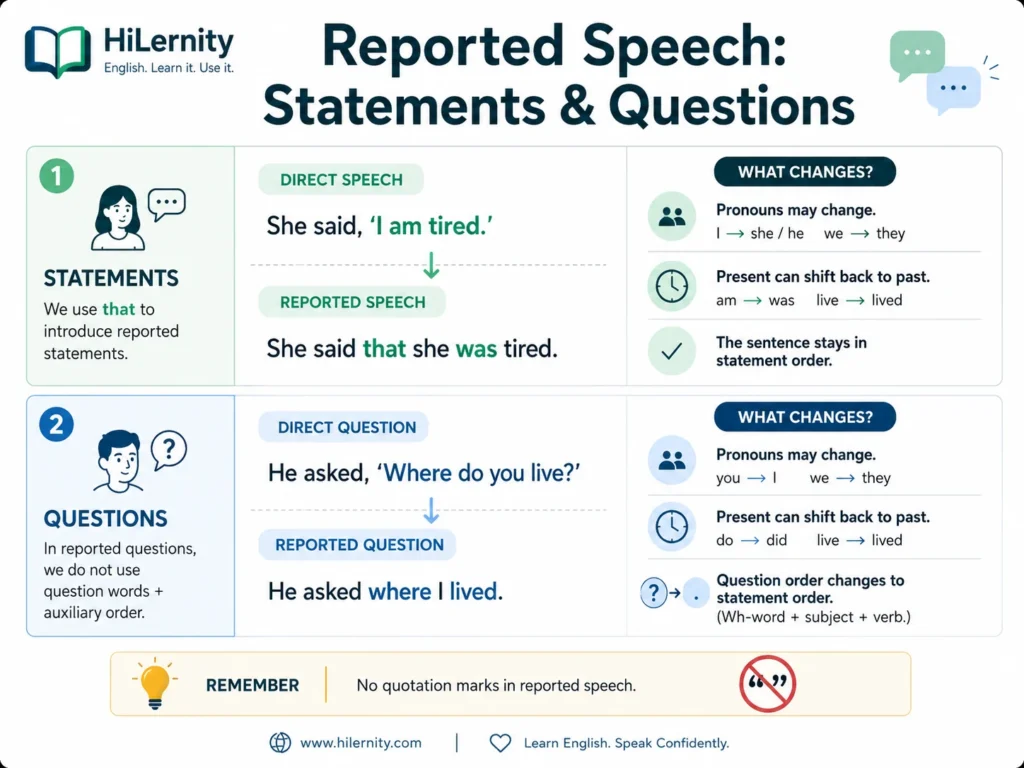
1. Direct speech and reported speech
Direct speech gives the speaker’s exact words:
Maria said, “I am tired.”
Reported speech gives the meaning without quotation marks:
Maria said that she was tired.
The message is the same, but the grammar now fits the person who is reporting it.
2. Reported statements
With statements, we often use said (that) or told + person + (that).
- He said, “I need more time.” → He said that he needed more time.
- She told me, “The meeting is online.” → She told me that the meeting was online.
That is often optional in natural conversation: He said he was busy is completely normal.
3. Backshift: when the tense moves back
When the reporting verb is in the past, the original tense often moves one step back:
- Present Simple → Past Simple: work → worked
- Present Continuous → Past Continuous: am working → was working
- Present Perfect → Past Perfect: have finished → had finished
- will → would; can → could
Backshift is common, but it is not mechanical. If the information is still true, speakers sometimes keep the original tense: The tutor said the course starts at nine can be natural when the timetable is still current.
4. Pronouns and time expressions
Pronouns change when the point of view changes. Time words can change too.
- “I will send it tomorrow.” → She said she would send it the next day.
- “We are meeting here today.” → They said they were meeting there that day.
Do not change a word simply because a table says so. Change it only when the real situation requires it.
5. Reported questions
Reported questions use statement word order. This is one of the most important rules.
- “Where do you live?” → He asked where I lived.
- “Why is she leaving?” → They asked why she was leaving.
Do not use do/does/did in the reported question, and do not invert the subject and verb.
6. Yes/no questions
For questions without a question word, use if or whether.
- “Are you ready?” → She asked if I was ready.
- “Did he call?” → I asked whether he had called.
Quick practice
- “I work from home on Fridays,” Dana said.
- “Where did you buy this book?” he asked me.
- “Can you join the call?” the manager asked.
- “We have finished the report,” they said.
Suggested answers: Dana said that she worked from home on Fridays. He asked me where I had bought the book. The manager asked if I could join the call. They said that they had finished the report.
Final tip: first decide who is speaking now, then adjust pronouns, time and word order. Meaning comes before the rule.
Want to practise this with a tutor?
Work through the topic one-to-one and get feedback that matches your level and learning goals.
Find an English Tutor